
Wildwood, Laika Studios, and Anti-AI Counter Culture


Lately, despite my best efforts, my algorithms have been filled with AI-generated ads, cartoons, and pictures of friends and coworkers. If it’s not pictures or captions generated by the AI, it’s articles about the companies that host these programs and their friends in our own government who are allowing these companies to run wild despite pushback from their constituents. These programs are slowly but surely corrupting not only our minds but our land and infrastructure. I find the amount of AI that the general public uses to be nauseating. Even before my screening of Laika Studios’ Wildwood there was a new, AI-generated ad for Fanta, which is owned by Coca-Cola; a company worth hundreds of billions of dollars. The use of AI frustrates me on any scale, but when a company that is perfectly capable of paying contributors for real ad campaigns chooses to use it, that is when I become more angry than frustrated. That’s why productions like Wildwood are a much-needed breath of fresh air.
Laika Studios is famous for its work in stop-motion animation. Their first film, Coraline (2009), is the most well-known from the studio, but its whole catalog is jam-packed with stunning works. Wildwood has been in production for nearly 16 years, beginning its early phases after the release of Coraline. Principal photography of the film took the studio over 4 years, with animators saying that during the 40 hour+ work weeks they would only have a few seconds of footage. Wildwood’s scale of production is a marvel in and of itself. The set featured more than 200 unique puppets that used over 140,000 individual face plates. Yes, 140,000.
The studio also developed new features for their stop-motion figures. One of which is muscles that move and contract the way that a human’s actually would. So if a character moved its arm in a specific way, the bicep would contract. The team also developed a teardrop that could be 3D printed and actually be animated to roll down a character’s face. One of the most impressive feats is on their largest character model for the film, The General, a giant eagle who leads the bird faction. The puppet was 34 inches long with a wingspan of 64 inches. The model also included over 3000 individually placed feathers. The most impressive thing is that this model is really not in the film for all that long. The crew was willing to put in the effort to for less than 15 minutes of screen time.

The craftsmanship of Wildwood at times overwhelmed me. Thinking about the human interaction that every single frame takes not only astonishes me but inspires me. Never have I wanted more to create something than after seeing Wildwood. Stop-motion has always been impressive to see come to life, from Aardman Studios’ Wallace & Gromit projects, Tim Burton’s string of stop motion films, and most recently, Guillermo Del Toro’s Pinocchio at Netflix. These types of projects have a special place in the cultural zeitgeist. No matter what new tech makes it way into film making, stop-motion remains a long a grueling process. Frame by frame, things must be moved and changed to keep continuity. Even things like CGI are limited or nonexistent in these projects, used only to supplement things or remove rigging from the shots.
But now, AI is infecting Hollywood. A major studio, executive, director, or actor doing an interview talking about how they plan to incorporate AI into an upcoming project or how they’ve used their personal wealth to buy into or create an AI start-up seems like a daily occurrence now. Some really talented artists have broken my heart with their announcement. People who have been making films for longer than digital cameras have existed are now taking the cheap and easy route. Martin Scorsese, a multi-decade award-winning director, was one of the ones that was the hardest to hear. But he is unfortunately just the tip of the iceberg. Directors like Steven Soderbergh, Peter Jackson, Darren Aronofsky, Zack Snyder, and David Fincher have all been voicing their positive opinions on generative AI, in everything from storyboarding, to filming, to post-production. These are directors who, for the most part, are not only popular, but make generally well-received films.
The music industry is being plagued by AI slop too. Just a few short weeks ago, Spotify announced that it has removed 50 million AI tracks after flagging and removing 75 million last year. This platform makes more money than it knows what to do with while not properly paying the artists who drive traffic to their apps, and were just letting this slide until very recently. I’m sure we all have a few people in our lives who have tried to show us music that is immediately recognizable as AI-generated. It’s trash and is somehow being created and published in droves.

I think that one of the most common arguments from people who are AI enthusiasts is that those of us who are against AI are of the same mentality as people who disliked the debut of the automobile in the early 1900’s or that we’re afraid of the inevitable progress of technology. I don’t want to speak for everyone, but I’m not afraid of AI; I’m angered by it. But fear is also a fair response. Essentially, every sci-fi story involving Artificial Intelligence is meant to be a cautionary tale against it. Terminator, 2001: A Space Odyssey, Dune. The list goes on. But as soon as a free chatbot that will never tell you you’re wrong is introduced, our collective memory of the parables goes entirely out the window.
All of that being said, I do feel that there is a movement against these things. Many people whom I’ve run into, both online and in person, are adamantly against these programs and companies. Not to mention the artists and creators who are taking a stand against it. Art in general has always been a place where counterculture thrives. So when art, especially digital art in the mainstream is starting to become chock full or AI and corporate garbage, the counterculture turns to things that are strictly handmade. Studios like Laika, directors like Guillermo Del Toro and Christopher Nolan are all fighting the good fight. Audiences are showing up for it. Nolan, for example, put out The Odyssey earlier this year. That film made $1.8 billion in its initial theatrical run. This is a film adapted from an epic poem that relies heavily on practical effects and camera work rather than CGI. AI is nowhere near this picture. Whether they know it or not, audiences made a statement by showing up for this film. Studios will likely take away the wrong message, but it’s there nonetheless.
Wildwood is a film that is not only anti-AI in its production but also in its messaging. Some of the central plot revolves around a thick forest where magic is a massive part of the world. Dark magic is used by the central villain of the film in an attempt to bring her deceased son back to life. This is the only mention of dark magic in the film. It happens to be tied to both imitating something and the use of robotics to take the place of a person. Other instances pop up here and there in the film. The one that sticks with me and feels the most like the production team taking a stance with is when the protagonist, Prue, and her baby brother, Mac, are riding through the city of Portland and they whiz by a woman seated at a table selling her goods with a sign that reads “Enjoy handmade art, before its gone for good!” the sign is in the background in one of those blink and you’ll miss it sequences, but given the amount of work that the production team put into it, it clearly was intentional.
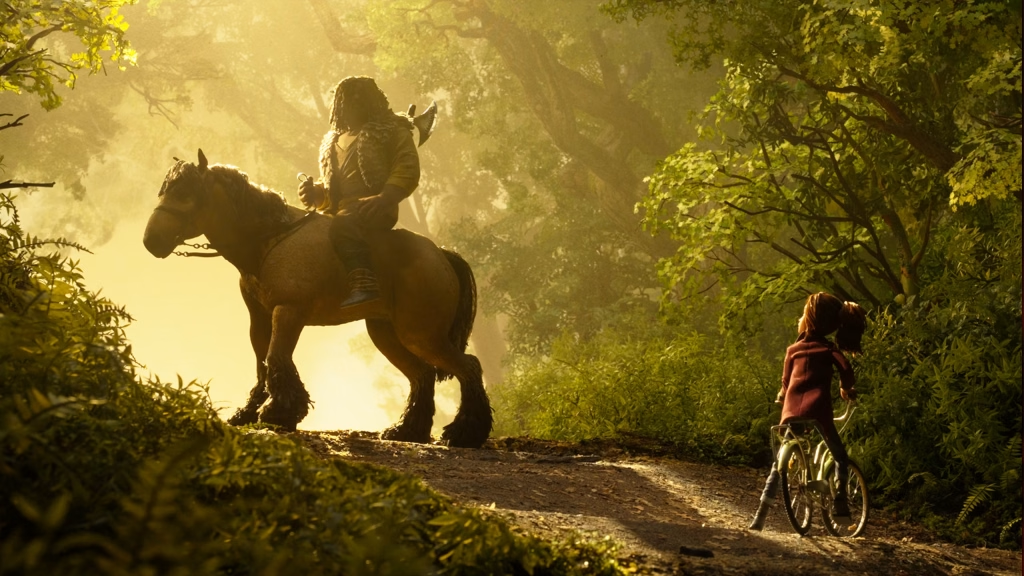
Laika Studios’ president and the director of Wildwood, Travis Knight, and others who worked on the film, have made their stance on AI very public. Travis Knight said recently in an interview:
Seeing creatives with this stance does give me hope and inspiration, but also pushes me further toward the idea that this is the route that counterculture will be moving. Analog over digital entertainment solutions. Physical media over streaming services, handmade products from real people. Laika Studios, in its run of films, has only been profitable once, with its first film, Coraline. Since then, none of their films have turned a profit. They don’t let this scare them away from creating more art. Any other major studio would sell of or shut down after a box office flop. Look at the DC Studios debacle as of late. That’s a Pandora’s box I won’t open here.
Beyond seeing Wildwood as a way to support real art, you’ll also be greeted with a really lovely film that is full of heart. The story is well crafted and thematically dense, and I’m planning to read the novels the film is based on, to gain a deeper understanding of the characters. The film has a strong chance to win Best Animated Feature Film at the next Academy Awards. In a just world it would also receive a Best Picture nomination, and even be in the running to win. However, it’s more than likely to be overlooked come awards season, outside the animation categories, given the very strong slate of films this. If for nothing else I implore you to see Wildwood, in the cinema or at home, because it is a film more than worth your time, made by humans – very creative humans at that. Enjoy handmade art, before its gone for good.


