

Universal Monsters

Monsters have been part of our culture since humans first started telling stories. Simply put, a good monster can take any form we need to discuss our own fears. A monster can be me; a monster can be you; it can be internal or external, but no matter what, a monster symbolizes something else. Fiction has created a litany of monsters, some based on tales that span history and others new creations that tackle contemporary issues; the monster will never leave us because it is a part of us. Despite the sheer number of monsters, you’d be hard-pressed to find any as iconic as the Universal Monsters titans of the film industry, whose presence in pop culture can be felt everywhere you look, from films and games, to comics.
With us at GateCrashers celebrating Halloween, what better time to discuss what makes the Universal Monsters special? For new and old fans alike, I’ve created an aid to help people experience the wonders of horror’s oldest icons, from Dracula to the Phantom of the Opera. For each of the iconic monsters, we will dig into what themes it brings to the table, discuss the original films of the classic era of monster horror, and finally discuss the related title over at Skybound and Universal Studios’ Universal Monsters initiative, in which each monster gets a new 4-issue story reimagining, adding to or following up on what came before for a new audience.
So join me for this true monster mash, and spoilers ahead for the various titles mentioned.

The Wolf Man

Werewolves are iconic, from their rich history in cultures around the world to their gigantic waves through pop culture; everyone can understand the concept of a person who, for whatever reason, becomes a monster. The popularity of the werewolf can never be overstated, but to me, its longevity has always come from its ability to communicate a deep, emotional fear of losing one’s identity. At their core, great werewolf stories tackle the disparity between us as people and us as animals. This clash of identity, inherent in the fear the werewolf creates, is a versatile trope for exploring the intersection of various identities. No matter who you are, you can relate to losing yourself to external forces. While werewolves in the horror genre become a meditation on society’s ability to ostracise those who don’t ‘fit in’, the horror werewolf turns that ostracism inward, examining how we manage parts of our own identity and how that can alter the world around us.
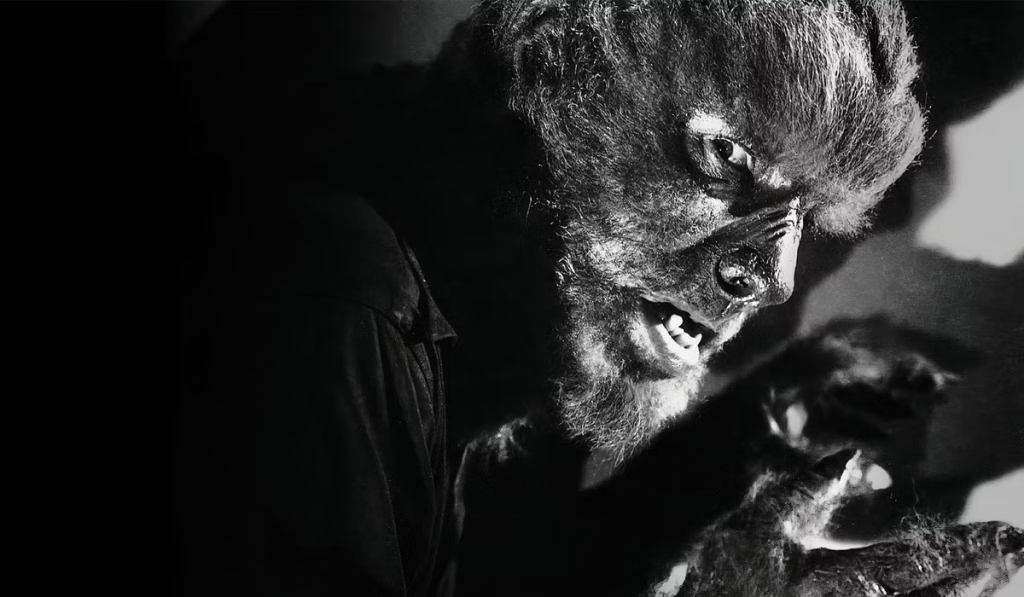
The thin line between man and animal is where Universal’s The Wolf-Man (1941) comes into play. Clear from both the title, The Wolf-Man, and the design that highlights both identities, this genuinely excellent film centers its horror on losing oneself to an animalistic other, similar to the Freudian concept of the ID. The horror comes from the transformation the main character, Larry Talbot, undergoes. Larry is a ‘self-made’ all-American man coming home to his estranged father in Britain, unprepared for the supernatural presence in the area, which will lead to his horrifying curse. After being bitten by a werewolf, Larry is slowly turned into the wolf-man, hurting those around him in a spiral that watches him unravel into a tragic end at the hands of his loved ones. This film, in my opinion, is the Universal Monsters film with the richest thematic presence; Larry’s transformation and loss of self are scarier than any jump scare later adaptations would rely on. It leaves you as an audience member sitting with its implications. This thematic richness comes from the scriptwriter Curt Siodmak, who drew the loss of identity and persecution from his own experience as a Jewish man escaping Nazi Germany. Therefore, Siodmak treats the werewolf’s existentialism as the true horror at the heart of the monster and, in doing so, cemented its legacy in the second half of the classic era of Universal monsters.

If, like me, you’re fascinated by identity transformation, you’ll be intrigued by the new Blood of the Wolf Man miniseries, an excellent spiritual sequel to the original film. Written by Joshua Williamson and illustrated by Leomacs, the comic explores the identity at the heart of the monster. Williamson’s approach focuses on the central theme of growing up as we follow Adam Jaeger, who, in his college years, is transformed into the wolf-man. This take makes the Wolf-Man an allegory for growing up, and Williamson uses the original film’s family estrangement to explore fractured home dynamics and their effects on self-identity. This book also features incredible art by Leomacs, who brings both calm reflection and blood-soaked violence to the narrative, supported by Pip Martins’ outstanding color work, which helps balance the tones needed for a story like this. Whilst not a straight adaptation of the original film, it’s certainly the strongest retelling of the film’s themes to date.
Frankenstein

Frankenstein, as Mary Shelley intended, explores the central question of science and its twisting into morally questionable acts. At the same time, it changes how we see what a monster is: what do they look like? And what do they represent? Many know that the truth of Shelley’s original Modern Prometheus is that Frankenstein is the monster at the heart of the story; his tireless pursuit to upend the natural world with his experiments and his subsequent treatment of the baby-minded creation, turning him into a monster, is what makes the novel so compelling. The tale of Frankenstein is one of those foundational ruminations on the Nature versus Nurture debate, challenging us to speculate on what guides our actions and who determines our choices. The Monster of Frankenstein is a victim never being given a choice; his path seems predetermined and is only reinforced by actions he makes in reaction to a world which seems set on creating monstrous outcomes, this tragic element to the monster. Therefore, Frankenstein is unique in the Universal Monsters catalog, not only because it’s an adaptation of an original work, but because its Monster is a shell through which its theme explores a far more real monster: Frankenstein himself. As an adaptation, it also gains a life of its own, offering a unique version of the tale that examines the disparity between what it means to be human and what it means to be a monster.

James Whale’s Frankenstein (1931) follows Henry Frankenstein (no, not Victor for some reason) as he tries to play God, reviving a corpse, and, due to his unstable nature, eventually leads to the creation of a monster which terrorizes the nearby town and Henry’s personal life. It is fair to say it has become as iconic and recognizable as Mary Shelley’s original novel. Much of the pop culture understanding of Frankenstein and his Monster comes from the changes made in this film, the most notable being the iconic design of the large-headed green man in a ragged jacket, with his stitch-riddled skin, all brought to life by the standout actor of the film, Boris Karloff, who quite frankly steals every scene he is in, as the monster should do in my opinion. The use of lightning to revive the creature was also a film original, presented in the electrifying performance from Colin Clive screaming “It’s alive”.
There is no doubt that the film wants the audience to dislike Frankenstein as a person. We first meet him through his mid-grave robbery, and throughout the film, characters like Elizabeth make it clear Frankenstein is a maniac in every sense of the word, ignoring his loved ones and his own wedding to Elizabeth. However, the film does alter the makeup of the monster; in this version, the monster’s actions are less of a message on poor parenting but instead laid at the blame of a criminal’s brain, which is told to the audience to have genetic abnormalities, suggesting a biological difference in criminals, which does sadly muddy the themes of humanity and monster with an air of depressing biological determinism and ironically detracts from the tragic elements that are integral to the monster. Regardless, the film still makes it clear that Frankenstein is the true monster; even if he escapes, he deserves his fate in the film’s climax. While many film adaptations exist, none of the Universal Monsters feel original enough to warrant a fair distinction.

These questions sit on the line between man and monster, as Image Comics and Skybound’s Frankenstein series, written and drawn by Michael Walsh, reassesses them. This comic runs parallel to the film. It adds a new perspective to this tragic tale by rehumanizing the process that created the monster. It’s told from the perspective of Paul, an orphaned child whose father’s body Frankenstein uses for his creation. Throughout, the comic delves into the depravity at the heart of taking others and bending them against nature, with each issue centering its theme on titular body parts, each introduced to the reader with gorgeous Splash pages. Paul adds a unique element to the classic tale. Often, Paul mirrors Frankenstein in the experience and perspectives on life and death; therefore, Paul’s inclusion does not interrupt the plot or ending of the original film, but by being a character who is personally affected by Frankenstein’s actions, we come to understand the themes of what it means to be human more clearly.
Each choice to focus on a part of the monster contextualizes the narrative within the town, giving more weight to the actions of both Frankenstein and his monster. Walsh also focuses the reader on body parts that offer deeper insight into the character; for example, Frankenstein’s eyes are always shown as beady green centers in a larger blackness, revealing the madness and depravity that drives his quest to answer the unknown. The focus on body parts is a simple, elegant continuation of both the film’s and the book’s themes that, in my opinion, elevates the original film and adds a much-needed reinjection of tragedy into the monster. The series also makes up for some of the shortcomings of the original film, mainly helping develop Elizabeth’s character a little more through her interactions with Paul, showing her kindness in a parental fashion which mirrors both Paul’s struggle with his father’s death and Frankenstein’s trauma from his mother’s death as a child. Overall, this comic is my personal favorite from the line as a whole, and I really would encourage you to experience it.
Dracula

Could there ever be a more iconic monster than the Vampire? And out of every vampire, who is more infamous than Count Dracula, created in ‘modern’ literature by Bram Stoker in 1897. A tale told through the letters of John Harker and others, that follows John as he travels to visit the Count in order to sell him a property in England whilst being caught up in the danger as the Count seeks out his fiancée Mina, who has become the Count’s target. This book is unlike Frankenstein and the other book adaptations in the Universal Monsters lineup for a reason. While Stoker did not invent the vampire, he altered the monster’s allegorical presence to reflect the fears of his time. Stoker’s Vampire represents two societal fears:
- The fear of the stranger, both savage and sophisticated, is why Stoker loosely based the Count on Wallachian noble Vlad the Impaler
- The fear of lust, which had been altering the moral foundation of Victorian society, is why the story of Dracula often comes with sexual connotations of subtext, hence the biting of the neck or heart to draw blood or the leaving of an illness through blood. Dracula therefore becomes a symbol of transgressiveness in the realm of a sexual status quo; victims of the Count are any gender and of any class, either forced or charmed by the Count in equal measure.
Through this, Stoker made one of fiction’s most iconic villains. A monstrous man who can outsmart his victims just as easily as he can overpower them. Like Frankenstein, it’s no shock that Universal Studios set out to adapt the Count to the big screen.

Universal Studios’ Dracula (1931), directed by Tod Browning, is a true gothic horror film; countless times, its shots have shocked me with a clear, deliberate focus on lighting to create a palpable atmosphere. The film does take liberties with the source material; in this version, Dracula’s assistant, Renfield, is the solicitor who visits the Count, is turned in the film’s opening act, and takes Dracula to London for the rest of the film’s runtime. The focus on Renfield as this infected victim of the film makes it an interesting departure, as Renfield becomes the center of the film’s focus on science versus the supernatural played out by the characters Van Helsing and Dr. Seward. The film also carries the sexual undertones of the vampire. Dracula includes many scenes of the Count targeting people in London, including Mina’s friend Lucy, who is obsessed with his charm and allure. In the end, Helsing, Mina, and Harker finally slay the Count.
The film’s performances are entertaining throughout; Helen Chandler as Mina gets a surprising amount to do, if not much, for a film of this era. Edward Van Sloan plays the older, experienced, and calm Helsing well and is a solid core to the film’s exploration of rational belief and disease, which the vampire represents. As mentioned, Reinfield gets a lot of great scenes, played excellently by Dwight Frye, who captures the fear and control the count has over him as he spirals further and further into madness, despite his abrupt death. The true star is Bela Lugosi as Dracula; his performance is mesmerizing; he steals every scene he is in, whether as a menacing force or in the ways he interacts and manipulates the cast before they catch on to his game. Using only shadows and Lugosi’s physical performance, the audience is carried effortlessly through the film’s emotions. This portrayal is the standard for Dracula for a reason: the accent, clothes, and mannerisms are perfect, and the film is worth seeing for his performance alone.

The Universal Monsters comic series Dracula, written by James Tynion IV and art by Martin Simmonds, operates in a similar manner to the Frankenstein series, acting as an accompanying piece to the original film, but unlike Frankenstein, Dracula doesn’t add additional characters; instead, it acts as an extended cut of the film. It focuses on Reinfield and his relationships with the cast throughout the film and between scenes, as each issue follows a section of the film before Reinfield’s death. This comic recontextualizes his character and adds more narrative weight to his decisions throughout the film, as both science and superstition are used to treat him. Whilst Tynion writes each character in line with the film’s characterization, I often left wanting more; therefore, of these series, the story felt the least ambitious, with its thematic attempts simply adding to and expanding ideas already present in the film.
However, what drew me to this comic was Simmonds’ outstanding art. I have been following Simmonds’ work for some time, and he is easily one of my favorite comic artists; his scratchy pencils and harsh lines, fused with fluid, splattered colors, blend wonder and horror in exciting ways. With these, he seems like the perfect fit for Dracula, who is treated as a force in the narrative; Dracula is entropy in this version, seen only in short bursts, detailed with gorgeous red to imply gore without falling into shock-and-awe territory. When red is used, it means the court is near, and in the face of Lugosi performance, I think this approach to the Count as more a force of nature than character was a great way to respect the film’s take whilst also showcasing the horror of the vampire. The way Martins draws the Count as a terrifying and oddly majestic creature also latches onto the monster’s transgressive core, supported by Tynion’s use of Reinfield to show that allure and control.
Phantom of the Opera

More than any of the monsters in Universal’s catalog of horror, the Phantom is an ‘ordinary’ man; whilst yes, he is a gifted ventriloquist, has almost comical skills as an escape artist, and is often disfigured, the Phantom, aka Erik, is simply a man in the original novel by writer Gaston Leroux. Erik, for all intents and purposes, is the extreme of the troubled artist; he is both dangerous and pathetic in demeanor. His actions are fueled by a controlling view on love and a desire to be grander than the life he has been allotted. For these reasons, he latches onto Christiane Daaé, loathes her love interest Raoul, and terrorizes the opera house. In the end, Erik wished to be loved and, in the absence of that, feared, donning the persona, using his aforementioned skills and knowledge of the building, to become something far greater than simply the pathetic and tragic man he sees himself to be. I find this line fascinating when placed alongside the other Universal Monsters discussed, where the rest (for the most part) are monsters with redeeming qualities that clash with the fear they generate; Erik is frightful and ultimately pathetic in a way that makes you feel for him. I think it’s fair to say that if Leroux wrote this book today, many would see Erik in a similar light to that of the incels, men whose own self-humiliation cycles both make you feel sorry for them whilst you cringe and curdle at what their self-deprecation pushed them to do.

Whilst there has been many adaptations of this story varying wildly in depictions and accuracy, the one which seems strikingly most accurate is the 1925 silent film Phantom of the Opera, which has its own fascinating real world history as party lost media that I encourage you to check out. The film hews fairly closely to the book’s plot: After changing management hands, the new owners of the Paris opera house are greeted with the notion that a Ghost haunts the house, these rumors seem true as actor Christine Daaé, mourning her musically gifted father, is visited by the ‘spirit of music’ who demands she perform for him as the lead in the Opera showings. After a horrific accident orchestrated by the Ghost ruins the performance of the other lead, Carlotta, Christine has no choice. Christine and the Ghost are then discovered by Raoul, who loves Christine; he sets out to free her from the ghost’s sway. The Ghost, revealed to be a man named Erik who lives beneath the opera house, grows ever more obsessed and dangerous, capturing Raoul and Christine in his dungeon. In the end, Christine convinces Erik to let Raoul go; a mob kills Erik as Raoul and Christine escape. The film trades in a few major characters from the book and heavily alters the ending to streamline the plot, but sadly loses some of the more interesting character moments with Erik and his emotional unraveling. For me, it doesn’t help that the film’s silent nature also gives the actors little room to work within their portrayals. The standout, unsurprisingly, is Lon Channy as the ghost/Erik, who in this is far more monstrous-looking under the mask but has this creepy, inhuman veil of mystery around him, which is ironic, as this version of the Ghost has the least inhuman feats throughout the film’s runtime.

The comic series by the same name, written by Tyler Boss and illustrated by the aforementioned incredible Martin Simmonds, is a unique take on the original film. Unlike some of the other series discussed, this comic doesn’t add to the original film or follow up its events; instead, it reimagines the film and book. Boss takes the basic outline of the story and pushes it in surprisingly new directions; scenes are in unique orders that create more mystery around the Ghost. The Ghost’s identity is also an original change unique to this adaptation, as far as I know; without spoiling it, the changes to the Ghost’s identity change the dynamic with Christine. Instead of the ghost being a wanting admirer turned dangerous obsessionist, his relationship with Christine centers on his desire for her to excel as an artist, using her father’s passing to push her higher.
This shift cements the thematic rearrangement: Boss’s version plays with the angel-for-the-tortured-artist dynamic and the dangerous climb to fame and admiration. Many characters act in this interest to raise their own fame, which the Ghost exploits; this thematic change is not out of nowhere, as mentioned, fame and its cost is an integral part of the film’s ideas, but this series plays more with the Ghost being the ‘Spirit of music’ more than a monster. Raoul is fairly similar to his film counterpart, if not more reserved, and at points feels like he has little to do, simply moving the plot forward as we focus on the Ghost and Christine. This focus is clear in Simmonds’ artwork; multiple splash pages are dedicated to the ethereal, unnatural depiction of the Ghost, which feels far less human than other versions until the final issue. Like his work on Dracula, Simmonds uses his unique style to capture the larger-than-life presence of this iconic character, and for me, that was the creative glue that held the series together.
The Invisible Man

The final member of our mini group of Universal Monsters based on original novels is The Invisible Man, created by H.G. Wells, one of the founding fathers of science fiction; the novel tracks the discovery of a scientist who has turned himself invisible and, from that point on, attempts to wreak havoc across England. Most similar to Frankenstein or Creature from the Black Lagoon, The Invisible Man is far more immersed in science than the supernatural. Griffin is a mad scientist through and through, and his experiments bring out his vicious nature as the opportunities his powers give him push him toward darker and darker pursuits. The Invisible Man‘s human core is what makes him, in my opinion, one of the more terrifying members of this monstrous bunch. Griffin’s choice to live this way and keep this darkness inside reminds us that monsters are, in many ways, a reflection of how we feel about ourselves. The idea of turning invisibility, a power fantasy many people think, into this wicked act is incredibly powerful. The heart of the film’s horror is the abstract idea of being seen, which plays out across the many versions of this tale. The implications of what an invisible person could do are far more potent than anything we could show as an audience. Therefore, Griffin encompasses an ever-present paranoia: the idea that horror is all around us just out of sight.

The film of the same name was released in 1933, directed by James Whale, hot on the heels of Frankenstein. The film makes its approach clear by portraying Griffin as a far more manic and psychopathic figure than his book counterpart. Only at the film’s close do we see Griffin as anything other than the mad, invisible genius who torments our film’s cast and the town of Iping. Throughout the film, Griffin escalates his rampage as police, aided by his lab partner, a romantic rival, Kemp, his fiancée Flora, and Flora’s father and Griffin’s scientific mentor, Cranley. This film, for me, feels at odds with itself throughout. You can feel the narrative wrestle with the dark implications of a character like Griffin, especially in the second half when he goes on a killing spree that would make the rest of our monster blush. However, this sinister and genuinely frightening portrayal seems at odds with the film’s insertion of various comedic and borderline slapstick elements set in the town that grind all dread to a halt; it feels almost like the film purposely subdues itself so that the audience doesn’t have to sit with the dark themes and ideas for too long.
This disconnect feels even more apparent in the performances; quite frankly, more than in any other film, Claude Rains as Griffin steals the show. His theatrical performance puts the rest of the cast to shame, as he is equally menacing, intelligent, manic, and funny throughout. His performance is the film’s lasting legacy and is only elevated by the outstanding effects work of John P. Fulton, which still holds up today. Outside of Griffin, the rest of the cast leaves much to be desired. Kemp is the only one with much work put into his relationship with Griffin, as Griffin terrorizes him in his home, but their past is mostly inferred through dialogue before being shown. Cranley and Flora, as original characters in this story, are bland, feeling like an afterthought, and like Whale took his Frankenstein script and simply swapped out the names before shoehorning them into this. Flora only does anything in the film’s climax, which, once again, thanks to Rain’s performance, ends the film on a somber, tragic note. While the film is easily one of Universal Monsters’ best, it often loses the horror factor that would make it on par with Dracula or The Wolf-Man. If you liked the film like me but want a more horror-focused take unshackled from comedy, I highly recommend the 2020 adaptation, The Invisible Man, which, despite its drastically different plot, shows the horror an invisible man could truly wreak on someone’s life.

In Skybound and Image Comics’ The Invisible Man comic, this tonal dissonance is largely removed; written by James Tynion IV and illustrated by Dani, it functions like Tynion’s Dracula as an additional piece to the original film. The series focuses on Griffin before the film. We see Griffin’s earlier experiments before he tests them on himself. Through Griffin’s perspective, we see his inherent darkness, which clashes with Flora’s love and hope, and that his experiments turned him mad. This reveal of the true depth of Griffin’s mind was really interesting to me and turned this series into less of an additional scene catalog and more of a full-blown character study that then elevates the original film. Tynion uses the fear of the invisible and internalizes it in Griffin, telling the audience that what drives him is his anger about how he is perceived and his obsession with what it means to want to be invisible to inflate his ego and indulge this power fantasy.
This is all juxtaposed by Griffin’s first victim of his test, a homeless boy called Tommy, whose horrifying transformation into an invisible man physiologically breaks him instead of empowering him. Tommy tells Griffin invisibility is a curse which makes you half a person forever cut out of others’ lives and reality; it’s the true absence of any form of power or connection. Griffin learns this lesson tragically at the film’s climax. Dani on this series is, as always, electric, using shadow and lighting techniques to obscure the characters’ vision or alter perspective, reinforcing the thematic weight of Tynion’s writing. The choice to draw the invisible characters in stark white silhouette is genius, as it warps the image around them while also stripping away individual detail, showcasing both the power and curse of invisibility in a thematically resonant way. In my opinion, this is the best this Skybound line has to offer and really is worth the read. Tynion and Dani’s approach blends the best elements of the original novel and the film’s take on Griffin to make a far more monstrous man.
The Mummy

First off, I need to be honest: The Mummy was always my least favorite of the Universal Monsters, but that doesn’t mean he doesn’t carry interesting themes unique to him. The horror of The Mummy has its roots not in fiction, but in Victorian colonial exploration of Egypt and the ‘discovery’ of tombs containing mummies in Victorian England. These discoveries created a cultural wave referred to as ‘Egyptomania’ in which, sadly, these tombs were desecrated and the bodies stolen for all manner of bizarre and macabre acts in upper British society. From this, the mummy’s turn into a feature of horror literature comes primarily from fear of the other in an abstract sense: an alien culture and rules that often play on Western characters who either don’t respect them or are foolish enough to challenge forces they simply can’t comprehend. This fear of the unknown, and reflection on the British’s horrid actions against Egyptian history, lie at the root of the original universal monster feature.

In 1932, The Mummy, directed by Karl Freund, follows the unearthing of the Mummy Imhotep in 1921 after the impatience of a British archaeologist reads out an ancient curse, which revives him. Imhotep walks the sands of Egypt until his return ten years later. This return coincides with the arrival of Ardath Bey, an Egyptian historian working under Sir Joseph, who discovered Imhotep, and Helen Grosvenor. Imhotep, now disguised as an Egyptian man, seeks to revive his long-lost love through Helen, whom he believes is her reincarnation. The film plays heavily on both themes of identity and obsession. Most of the British cast are relentless academics who push discovery with little care for the consequences of their actions; our lead, Adarth, helps Helen break free of Imhotep’s control. Unlike many love interests in these classic films, Helen has real development; her choice to reject Imhotep is fascinating, and the love triangle she is placed in, similar to Phantom of the Opera, always makes for compelling drama. Imhotep, played by the legendary Boris Karloff, is great on screen, and the more intelligent monster lets Karloff act in ways his role as the Frankenstein monster never could. However, whilst Imhotep is tragic like many other monsters, this tragedy feels less gripping than the others. The Mummy is a strong film and won me over more than I expected, even if a few of its plot points feel underbaked by the climax. It’s also worth a note that, whilst not a horror film, the 1999 film with Brendan Fraser is great and worth a watch alongside the original.

Skybound and Image Comics’ approach to the mummified menace, brought to life by creative team Faith Erin Hicks and Lee Loughbridge, dials down the horror and instead offers a story more attuned to its themes of identity and loss. A new retelling of the film’s plot makes Helen the central lead and focuses more on her dual Egyptian and British heritage, something the film attempts to do to some extent. Hicks also strengthens the connection between Helen and the Egyptian princess Ankh-es-en-Amon by having them share a mind throughout Helen’s life; this solidifies the idea of dual identities and the conversation around self-acceptance in this series. The other strong thematic point is loss; the book showcases Imhotep in a fairly fleshed-out regard as we see how loss has corrupted Imhotep into blinding obsessions, seeing Ankh-es-en-Amon less as a person and more as an object. This tragic romance becomes the book’s beating heart and, for me, holds everything together. However, I do have my problems with the series. My main issue, which is no fault of the creative team, is that it feels too short; the changes to Helen and Ankh’s relationship feel like they don’t get another chance to breathe and flesh out in unique ways. My other issue is that this is ultimately not a horror comic; while Lee Loughridge’s art is great and has fantastic displays of body horror with Imhotep’s decay, it doesn’t create a horror atmosphere like the other titles.
Creature from the Black Lagoon

The Creature from the Black Lagoon is seemingly the most forgotten monster in the Universal Monsters lineup, seeing no major adaptation in the decades since the classic era of monsters ended (not without many interesting attempts to remake the original, which are worth a Google). The creature is an evolutionary missing link that is discovered in the Amazon rainforest. Due to this complete lack of human connection, the fear is that he feels alien to us, out of time, clashing with the present. This is where both the tragedy of the creature and the strangely romantic elements play in; whilst seemingly alien, the creature is also incredibly primordial to us as a forgotten past to be admired whilst we are collapsing the world around us. The horror and tragedy of the creature are not rooted in its danger or unknown abilities, but in its representation of a lost past and its tragic collision with the present. If the subtext of the monster were more focused upon, the creature could become a powerful environmentalist piece surrounded by its more thematically darker counterparts. All this is to say the Creature, to me, is a little bit of the black sheep in the Universal Monsters family, whilst it has many of the trademarks you’ve not doubt noticed in the coverage of the rest of the monsters, i.e. tragedy, romance and a great design; the Creature is as seemingly isolated thematically as he is literally in the film, which I find fascinating as the thematic foundation of a monster.

Directed by Jack Arnold, Creature of the Black Lagoon (1954) follows a scientific expedition to the Amazon after Dr. Carl Maia discovers a fossilized hand of an unknown creature. Carl takes a group consisting of researchers David Reed, Kay Lawrence (David’s partner), Mark Williams (financier of the research), and Dr. Thompson aboard the boat called Rita as they enter the Black Lagoon. Shortly after their research begins, they encounter the creature, also called Gill-man, who attacks the crew, killing some and scaring Thompson. As William and David argue over the creature’s fate, the Gill-man seems infatuated with Kay. The tragedy of the creature is his isolation, both as the seemingly last of his kind and seen in the infatuation he has for Kay, intelligent enough to form some sort of emotional response but simply seen as a discovery or prize by our cast, minus Kay and David, who bring heart to the pursuit of science. Thematically, the film also explores life from the water to space, reflecting its release during the Cold War space race. The film’s use of water as both a force of wonder and fear made its cinematography stand out among its contemporaries. The underwater scenes are incredible to watch and make the creature terrifying, knowing it could appear from anywhere in the void. The creature itself, as mentioned, conveys many human qualities while still feeling alien and scary, all the more helped by the excellent practical design created by Milicent Patrick, Bud Westmore, Jack Kevan, and Chris Mueller Jr. The ending, which depicts the ambiguous death of the Gill-man, worked wonders for me in tying together scientific pursuit and natural tragedy, and I was glad the film ended on a more tragic note.

Creature From the Black Lagoon Lives! written by Ram V and Dan Watters and with art by Matthew Roberts, follows Kate Marsden, a journalist who is hunting Darwin Collier, a serial killer who drowns his victims and nearly kills her. This hunt leads her to the Black Lagoon, putting her in the creature’s path years after the original film. Thematically, Watters and V use the creature to explore obsession; every character has an obsessive vice that drives them through the narrative. Kate’s trauma from her near-death experience manifests itself not only in a dangerous obsession to find Darwin Collier but with the concept of water as well. As revealed in the book’s climax, Darwin is obsessed with becoming an apex predator, grafting parts of his body to resemble the creature to which he feels a primal connection. With this transformation, Darwin becomes the true monster of the series and the creature that lives in the series title.
Although the book is a sequel to the film, the two share strong continuity; most obviously, the characters reappear. Firstly, Kate is aided by Doctor Thompson, who, after the film’s conclusion, stayed in the lagoon to track down the creature; his obsession parallels Darwin’s. Most importantly, though, is the creature’s use: it carries the same air of danger and beauty in its actions, clearly intelligent and empathic, as it was with Kay in the film; the creature clearly feels for Kate in the end, helping her against Darwin. The creature’s isolation and loneliness, felt in its interactions, is shown in how the cast’s obsessions ultimately lead them to their own deaths, with a similar somber loneliness to what the creature experiences. Water functions similarly; it feels cold and isolating to both the character and the reader, and it provides a strong bridge between the cast. Matthew Roberts’s art is strong, and the creature’s design captures all the elements needed to make it both scary and sympathetic; some of these water pages are stunning and really sell the isolation and horror of this story. Of all the series under this initiative, this one takes the most unique angle: as a sequel to the original film, it can highlight the monster’s thematic core from a new perspective.
The Universal Monsters Will Continue

The Universal Monsters mean a lot of things; they are horror, romance, tragedies, and spectacles. It’s truly why these icons have stood the test of time, and with the recent announcement of The Bride of Frankenstein series at Skybound, it seems people still haven’t gotten their fix of some of horror’s most formidable figures, and I, for one, can’t wait to see what is in store for all these monsters in the years to come.


